LOREM IPSUM DOLOR
St. Philomena Parish
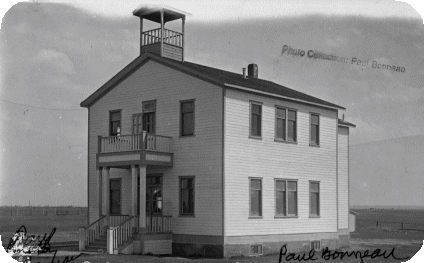
The First Chapel of Gravelbourg
The first Parish assembly was held on September 15th, 1907, under the presidency of Father Arthur Magnan. He was deeply interested in the opinions of his parishioners concerning the location of the first chapel.
The following, is an extract of a letter written by Pierre, Victor and Wilfred Larivière and Jean Hamon in 1907 : “We would like but one church in Gravelbourg, we would like it to be placed in the centre of the four townships reserved by the most Reverend Louis-Pierre Gravel – if possible, we would like the church on the west side of the river and on the section 36.”
Shortly after, it was decided that the future chapel house was to be built on the North-east quarter, Section 36, Township 10, Range 5, West of the 3rd Meridian, approximately where Collège Mathieu is presently situated.
In the fall of 1907, the settlers began to haul the lumber needed for the construction of the new chapel. These brave and courageous souls travelled as far as Mortlach, a sixty mile trip that took two to three days. On May 25th, 1908, the digging of the basement commenced. The building of the chapel house started on June 8th and was completed on July 16th, 1908. The cost of the total construction of the new chapel was $8,000.00. Father Magnan resided in the back of the chapel house and celebrated mass in the front. In 1910, the chapel house (Maison Blanche) was lengthened. On January 29th, 1911, the Vicar General of Saint Boniface, Reverend Dugas, authorized Father Magnan to inaugurate the Way of the Cross. The first solemn communion was held on May 18th, 1912.
Before and while the “Maison Blanche” was being built, Father Magnan would celebrate mass under a tent that was given by the government upon demand by Father Gravel. The following is a short historical extract written by Father Arthur Magnan in 1908 : “For many Sundays, I celebrated mass under a tent which belonged to the government. The wind having destroyed it in part, I then celebrated mass with Mr. Édouard Gauthier who had left the colony. I celebrated mass in that house for approximately two months. During the week, I said mass in the house of Charles LeMoine where I was later living and on Sundays we would celebrate mass at the home of Mr. Charles Archambault, a house made entirely out of sod, this lasted all winter. In the spring, I celebrated weekday mass under the tent and on Sundays, I said mass at Mr. Charles Archambault’s until the church was ready to be habitable.”
Upon the request of Father Louis-Pierre Gravel, His Excellency Archbishop Adélard Langevin, Archbishop of Saint Boniface, placed the newly founded parish under the patronage and protection of the precious little saint that was so dear to the Pastor of Ars, the Virgin and Martyr Saint Philomena.
In 1914, Gravelbourg had a population of 738 people (221 urban ; 517 rural). They had no other option but to build another church. Having little money, they could build only a basement for the future cathedral.
On June 15th, 1913, the chapel house or the “Maison Blanche” ( given the name of “Maison Blanche” due to the color of its white walls) was sold to the Gravelbourg School District No. 2244 for the sum of $4,000.00 and in 1914, was transported approximately to where the Oblate Sisters’ Jardin de Notre Dame (Giesen Apartments) is situated. It was used as a school house by the lay teachers until 1915 and soon after by the Sisters of Jesus and Mary from 1915-1918. In the fall of 1918, the “Maison Blanche” was transported a second time to the back of Collège Mathieu. In December of 1918, the Collège was not yet suitable for classes. The first classes of the Collège catholique de Gravelbourg were held in the “Maison Blanche” and in the “Maison Jaune”, a yellow house used by the Sisters of Jesus and Mary formerly situated on First Avenue. The former chapel house was given to the Oblate Fathers and used as a residence by the Oblate Sisters who were in charge of the upkeep of the Collège. In 1928, the famous “Maison Blanche” was restored and panelled with red brick.
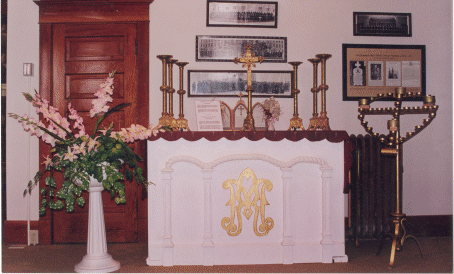
Father Arthur Magnan’s first altar
Early Parish Records
View the first baptisms, weddings, and funerals recorded in St. Philomena Parish.
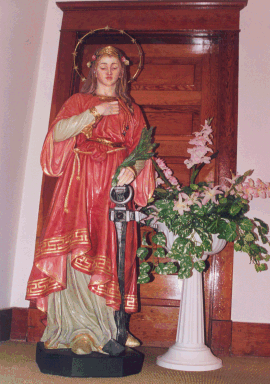
The Story of Saint Philomena
Learn about the life, devotion, and enduring legacy of Saint Philomena, the former patron saint of the Parish of Gravelbourg until 1963.