LOREM IPSUM DOLOR
Msgr. Charles A. Maillard, D.P.
Preserving Beauty, Faith, and History Through Art
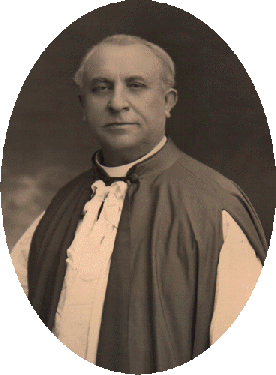
1873-1939
Early Life and Formation in France
The following information was extracted from the fourth Chapter, “Rapid developements and marvellous progress, 1915-1924”, of a manuscript written by Father Elie.-J. Auclair, Doctor of Theology and Canon Law and member of the Royal Canadian Society and of the Historical Society of Montreal, in 1930.
« Father Maillard was attending the Seminary in Lille, France when I first made his acquaintance in June of 1896. I had just completed my studies in Rome and Paris and decided to pay a visit to my Canadian friends who were studying in Lille, as well. The young Maillard, wanting to converse with another Canadian, immediately introduced himself. We had an intriguing conversation that left me with fond memories. His intentions were to immigrate to Canada, with the permission of his Bishop from Arras, to perhaps offer himself to Bishop Langevin in Saint Boniface.
Msgr. Charles Adrien Maillard was born in Montreuil-sur-mer, in the Pas-de-calais, of the Arras Diocese, France, on March 11, 1873. He began his studies at Sainte Austreberthe and later in Arras and in Lille from 1881 to 1894. He postponed his studies for a compulsory year of military service with the French Army in Saint Omer. Charles Maillard completed his first year of theology at the Major Seminary of Arras and received his minor religious orders. His father, Jules Maillard, a distinguished musician and reputable journalist for the “Montreuilloise“, a Catholic and Royalist publication, died relatively young at the age of 48 years old in December of 1888. His mother, Clémence Didier-Willox, from a religious and cultured family, also died at the age of 48 years old in October of 1893. His only brother, Emile, who was one year his elder, died in 1892. Maillard had only two sisters remaining of his immediate family, Marie, who was married, and Jeanne, who was still a young girl. Together his sisters immigrated to Winnipeg, Manitoba in Canada with his brother-in-law, Louis Worms, who was a teacher, in 1896.
Mrs. Maillard, Charles’ mother, passed away offering her sufferances and her life to God for “the good of her children“. Mr. Jules Maillard, Charles’ father, a fervent Catholic and faithful Royalist, shared these simple, but significative last words before passing on:“I will continue to work for the good of God as long as I still have blood running through my veins.” It was only natural that a religious vocation would take root in Charles’ soul.
Charles had cultivated an artistic vocation as well. Ever since he was a young boy in Montreuil, in Saint Austreberthe and while he studied in Arras and in Lille, Charles could not detain himself from either drawing or sketching. In Lille, he was fortunate to be able to cultivate his artistic abilities at the school of a master painter, Monsieur De Retz, who was a student of the Grand Master Jules-Adolphe Breton, one of the leaders of the French surrealist movement. Charles, wanting to choose a vocation, wondered if he could fulfill his artistic talent and religious vocation together. He passionately believed that he could and would.
Monseigneur Deramcourt, Director of the Arras Seminary, strongly encouraged him to pursue his interests in both art and religion, as did his military commander. His commander, Maginez, included a personal note along with Charles’ discharge papers thanking him for painting a portrait of his mother. Maginez gave him a few words of encouragement: “…Dear Reverend, I would like to share but one thought with you; Why not be a priest-artist and not an artist-priest! …I pray to God and to the Virgin Mary that you should become an inspired religious painter that pours his Catholic Faith into his works, and above all, to do a genuine good to as many souls as possible…” (October 8, 1895). »
His Ministry in Canada
Charles Maillard continued to paint while he was Assistant Secretary for Archbishop Langevin and while he attended the Major Seminary in Ottawa. This gave him the necessary measures to develop his artistic talent, as well as pay for his sister Jeanne’s education. After spending two years at the Archbishop’s Residence in Saint Boniface and after studying three years of theology at the Major Seminary in Ottawa, Charles was ordained a priest on May 19, 1901, by Archbishop Langevin in Saint Nobert, Manitoba, where he served as assistant priest for one year in the Diocese of Bishop Ritchot.
In April of 1902, he was Pastor of Saint Lazare Parish where the Assiniboia and Qu’Appelle Rivers merge. Three years later in 1905, he was sent to Wolseley, Saskatchewan. In 1911, His Excellency Olivier-Elzéar Mathieu was elected Bishop of the newly founded Regina Diocese. The new Bishop had made Father Maillard a member of his Diocesan Council in the same year. In 1912, while Father Maillard was still acting as the Wolseley Parish Pastor, Bishop Mathieu invited him to accompany to Paris and Rome. This gave him the opportunity to visit the famous basilicas and sanctuaries in the Religious City of Popes. Having pleased His Piety, after an admittance with Pope Pius X, Maillard did not shy away from visiting the numerous and splendid Roman museums. When he returned to Wolseley, Father Maillard practised his pastoral ministry with zeal and painted with tremendous inspiration.
His Years in Gravelbourg
In the summer of 1917, Father Maillard was called to replace Father Magnan, the first Gravelbourg pastor, who was entrusted with the Ferland Parish. Father Maillard first visited Gravelbourg on September 11th and took possession of the parish on October 7th. As soon as the new pastor arrived in Gravelbourg, he paid a visit to each family in his care. These brave settlers, who had such Catholic spirit, welcomed their new pastor with deepest respect.
After he completed his visits, Father Maillard organized an assembly of all his parishioners in the Saint Jean-Baptiste Hall on December 21st, 1917. Amiable and engaging, persuasive and appealing, Father Maillard proposed that they offer the “basement”, that was already built for the future Cathedral in 1914, to Archbishop Mathieu for the foundations of a new college. He later suggested to this parishioners that they build a grand and beautiful church at the end of Gravelbourg’s Main Street, where it is presently standing. The proposition was accepted unanimously. Following the Feast Day of the Kings, Father Maillard was sent down East to search for an architect and to establish various loans. The Gravelbourg Parish chose the architect, J.-E. Fortin, from Montreal. He was to design the blue prints for the future church (Co-Cathedral), and would be charged with the supervison and direction of all construction. Father Maillard determinedly saught a list of contributors who would help lower the building costs of the future Temple of God. He would also put his artistic influence toward the designs of the future church and of the future presbytery (former Bishop’s residence). The building of the church began in June of 1918 and was completed in the autumn of 1919. Most Reverend Archbishop Mathieu blessed the beautifully constructed church on November 5th of the same year. The construction of the presbytery commenced in May of 1919 and was finished the following October.
During the month of November 1918, many Catholics and non-Catholics were deeply touched by Father Maillard’s charity when he generously transformed the Saint Jean-Baptiste Hall into an Emergency Hospital during the influenza epidemic. The hall was later disinfected and used as a temporary church that was able to accomodate 450 faithfuls.
Father Maillard, who was entrusted with the care of the Gravelbourg Parish and of the people’s spiritual needs, sacrificed his free time to the pictural decoration of the interior of the newly built church. “Since my arrival in Gravelbourg, I did not have a single moment to paint.” The priest-artist began painting the sanctuary of the church in 1921 and completed the decoration of the whole church in 1931.
In 1925, Father Maillard and other priests were granted the privilege of accompanying Archbishop Mathieu to the Eternal City (Rome). They had the pleasure and honour of assisting the canonizations of Saint Theresa of Jesus the Child (May 17th) and the Curé of Ars (May 31st) and of the beatification of the heroic Canadian Jesuit Martyrs of the XVIIth century (June 21st). They were also granted an audience before Saint Pope Pius XI. Once again, Father Maillard found inspiration and was able to strengthen his artistic conceptions after visiting the many illustrious museums and sanctuaries in Rome. When he returned to Gravelbourg, Father Maillard brought back souvenirs and gifts that were blessed for his parishioners, his family, the Collège, the Convent and for the presidents of all associations.
June of 1926 was the 25th anniversary of Father Maillard’s sacerdotal vocation. The religious institutions and the parishioners of Gravelbourg organized special celebrations to honour and to thank their worthy pastor. There were celebrations at the church, the Collège, the Convent, and in all of the institutions. A series of festivities and speeches were presented for the esteemed jubilee.
At this time, the decoration of the interior of the church was still in progress. The grandiose paintings in the sanctuary were deeply admired by all. Soon, he would begin to populate the church ceiling with celestial angels and significative symbols.
Shortly before Archbishop Mathieu passed away, he obtained from Pope Pius XI, a grand honour and magnificent favour for Gravelbourg, especially for its distinguished and zealous pastor. The Pope completely agreed with the nomination of Charles Maillard as Domestic Prelate. On October 30th, 1929, Father Maillard received the joyous news of his new title as Monsignor from Apostolic Delegate, His Excellency Bishop Cassulo, the very day of Archbishop Mathieu’s funeral.
Important news arrived in Gravelbourg on February 17th, 1930. A new diocese was being created and Gravelbourg was being elevated to the Episcopal rank. The Roman Decreet of the detachment of the Gravelbourg Diocese from the Regina Archdiocese dates January 31st, 1930. Msgr. Maillard, overjoyed that his church was transformed into a cathedral, greeted His Excellency J.M.R. Rodrigue, the first bishop of the new Gravelbourg Diocese, on September 17th, 1930. A few days later, Bishop Villeneuve made Msgr. Maillard a Diocesan Consultor and on January 1st, 1931, he was offered the position of Office Curator.
His Period of Rest
In July of 1934, due to constant fatigue and a weakened heart, Msgr. Maillard was forced to take a prolonged vacation away from the parish that was so dear to him. Bishop Melanson, Gravelbourg’s second bishop, acted as pastor of the Gravelbourg Parish while Msgr. Maillard was resting at his sister’s in Québec. Frequently in correspondance with Bishop Melanson, Msgr. Maillard wrote him the following letter on November 12th, 1934: “Dear Bishop…My thoughts are often reflected towards the town that I carry deep within my heart. I can only imagine the amount of work that you are faced with in Gravelbourg, and I often approach myself for not having the courage to have stayed and helped. If only my unwell weak body would respond to the desires of my soul, then I would not have to be so far away from the works that I have been so absorbed in for the past 16 years…You will be happy to know that my paint brushes will not retire to their boxes this winter. Bishop Langlois was quite impressed with my Way of the Cross paintings, just lately he has asked me to reproduce the same series of paintings for his new Cathedral in Valleyfield…”
The following extract is taken from Msgr. Maillard’s letter to Bishop Melanson, written from Québec on April 24th, 1935: “Dear Bishop…My heart is full of anguish and sorrow because I have to abandon a Parish, where I have devoted so many of my best years, when I was young and healthy, with only the noblest of intentions which resulted into the separation of a diocese and a nomination of a bishop…”
Being absent for more than a full year, Msgr Maillard wrote a letter to his Bishop informing him that he was not yet well enough to return to Gravelbourg. On December 17th, 1935, from Saint Lambert, Msgr. writes: “Dear Bishop…My health has improved from last year, but I do not feel capable, nor do I have the courage to assume an active ministry in the West…”
Msgr. Maillard finally returned to Gravelbourg as Office Curator on October 31st, 1937, after an absence of three and a half years. His health having weakened once more resulted in Msgr. Maillard’s decision to leave in August of the following year. The esteemed priest-artist passed away in Montreal on February 14th, 1939. At a funeral held in Gravelbourg for Msgr. Maillard on February 21st, the diocesan clergy and Catholics from all over filled the Cathedral to pay hommage and give their last respects to the Domestic Prelate. His body rests with his parishioners and with his dear friends, Father Gravel and Father Magnan, in the Gravelbourg Cemetery.
Msgr. Charles Maillard blessed the town of Gravelbourg with his many important works. He built and decorated a breathtaking Cathedral, and he was a key person in founding Collège Mathieu, the Precious Blood Monastery, St. Joseph’s Hospital and the Gravelbourg Diocese.
Msgr. Maillard’s Splendid Works
The masterpieces that Msgr. Maillard created, give a unique and significant meaning to the Gravelbourg Co-Cathedral. In its pictural decoration, Msgr. Maillard displays a short version of Catholic teachings. His gift enabled him to visually display our Christian beliefs in paintings that are expressive and true. The composition of the interior paintings of the Co-Cathedral divides into two subjects : the sanctuary represents the dogma; the nave represents the moral.With his impressive ability, Msgr. Maillard was able to paint scenesof the Old and New Testaments on the ceiling and on the walls. He accomplished the works of both a theologian and an artist with reknowned expertise. The Gravelbourg church was truly worthy of becoming a cathedral. Msgr. Maillard devoted ten years of his life (from 1921 to 1931) to the interior decoration of his church.
Msgr. Maillard had known since his youth that he would follow a path of artistic talent. He was a priest who could never truly give up painting. He often painted portraits and numerous paintings. Msgr. Maillard created two paintings for the Saint Boniface Cathedral. He painted a representation of the “Resurrection of Lazurus” and of the “Crucifixion” for his first parish church in Saint Lazare. He also decorated the sancturary in the Wolseley Parish and recreated a “Saint Ignatius” and a “Saint Francis of Xavier” for Willow Bunch. He painted a “Crowning of the Virgin Mary” for the Regina Cathedral and a “Way of the Cross” for the Valleyfield Cathedral. He created many other paintings for Saint Nobert, the Oblate Fathers’ Monastery in Chambly, at Richelieu, Saint Lambert, Salaberry, Lachute and perhaps elsewhere.
The talented priest-artist had little time to devote to his art work when he first arrived in Gravelbourg. There was the construction of a new church and many other parish duties that he was obliged to tend to. He pursued his artistic talent in the summer of 1921. By decorating the church, he’s proven himself a true Master of Art. The sanctuary, the ceiling, the nave, each design, arch and wall was patiently waiting for the skilful art work of Msgr. Maillard’s expert hand. It was a long process that required both desire and talent, as well as patience and time.
Msgr. Maillard did not know to how much painting he would commit. He simply asked permission to complete a few paintings – little did he know that it would turn into an obssession of ten years! All of his creations were painted on the inverse side of linoleum. He requested canvas, but it was much too expensive. Msgr. Maillard investigated another solution and soon realized that the backside of linoleum resembled the texture of canvas and was more affordable.
On September 20th, 1924, a reporter for the Leader Post wrote a special article that describes the way Msgr. Maillard painted his masterpieces.
“Father Maillard’s paintings are planned for months and weeks ahead. It takes months for a painting to be executed; a subjet must be selected, details of composition worked out, sketches made and materials prepared before the work upon the actual “canvas” can be commenced. Father Maillard’s studio is in the vestry of the church. He speaks regretfully of the light, which is not at all what an artist would desire. The windows are small and his equipment limited, but he is thankful for what he has. If he desires a model, which is not frequent because he often uses mannequins and dolls, his faithful parishioners willingly offer to sit in. A girl from the congregation posed as Saint Philomena and a few older men posed as models for other persons. Other times, he`ll paint subjects coming from certain illustrations from his important sacerdotal library. The little figures or dolls that he uses in his composition are brought from his native country, France. Every detail of anatomy and costume is perfect : the veins in the hands, the seams in the leather and cloth garments, the soles of the shoes. The facial expressions are left to the discretion of the artist. The easel that Father Maillard uses is of his own unique invention. It is as ponderous as a medieval catapult! Huge rollers are placed above and below the planks that support the « canvas » . The artist, when working, sits on a scaffolding similar to those used by scene painters.
Normally, the priest-artist of Gravelbourg is a friendly, chatty man, but his parishioners who have seen him engaged in his painting, tell a different story. “When Père Maillard paints, he is so different, oh la, la, so different!” He plunges into his work. Time, rest and food are nothing. When daylight falls, he continues with artificial illumination. When his assistants and housekeepers bring him food and drink and demand that he rest, Father Maillard stubbornly drives them away. He has been known to work a full day and night without a moments rest.
The summer months leave him no time for his loved art. There are three hundred families in his parish and he must pay a personal visit to each and every one of them. It is almost impossible to pay these families spiritual visits during the winter because of the roads.
As soon as the winter ice, snow and chilly winds return to the prairies, the priest-artist’s paint brush, palette and colors renew its game. Each precious moment that he can spare are reserved to his art creations.”
The following extract is from a letter written by Mr. Simon Mailhot in October of 1975.
“…I remember very little of Father Magnan, but I knew Father Maillard very well. He was very pious and devoted, but he had very little money.
I saw him working a few times, he had a great talent for art. I often helped his nephew, Charles Simard, with photography and I would examine some of his wooden models that he would use, when he was sketching the bone structure of a head and body for his paintings.
Towards the end of his life, when his health was beginning to fail, Msgr. Maillard must have done a superhuman effort to finish the decoration of the Cathedral. To paint the ceiling, he would lie flat on his back using scaffolds, which I’m sure was exhausting with the many trips climbing up and down.
I was present one day, when he painted Christ on his cross. Mr. Adam Schelhamer, a thin man, posed as his model. A few strokes of his paint brush, he would pause for a moment and kneel down to God with his hands directing to the sky, praying for inspiration to do a successful job.
I remember a time, when he hired a few children to trace lines that did not require to be perfectly straight on the imitations of curtains and they would also trace the frames around the Seven Capital Sins. I believe that the lines drawn by these amature painters are still visible.”
Msgr. Maillard’s paintings were inaugurated by Bishop Villeneuve on May 5th, 1931. On this day, the priest-artist explained the meaning of each religious painting to the clergy and to his parishioners.
Today, visitors come from all places to admire his paintings and to pay their respects to the distinguished “curé de Gravelbourg”, who has bequeathed upon us a very cultural and spiritual heritage.
Today, visitors come from all places to admire his paintings and to pay their respects to the distinguished “curé de Gravelbourg”, who has bequeathed upon us a very cultural and spiritual heritage.