LOREM IPSUM DOLOR
The Paintings in the Sanctuary
The paintings surrounding the sanctuary bring together key moments in the story of salvation. From humanity’s fall and the promise of redemption to the Transfiguration, Resurrection, and the crowning of Mary in heaven, these works draw the eye and heart toward Christ and the mystery of our faith.
The Condemnation of Adam and Eve
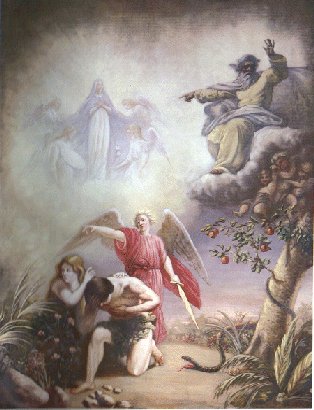
This painting portrays the condemnation of Adam and Eve and their expulsion from the Garden of Eden. While the Archangel with the flaming sword expels the fallen couple, God looks on, simultaneously condemning the serpent with an angry regard while pointing to the Virgin whose role in the Incarnation will effectively assure both the redemption of Adam’s descendants and the destruction of the forces of Evil. Note that Adam and Eve cling symbolically to each other for mutual support and that the road from Eden is covered with thorns and stones. But the message of the painting is dominated by the promise of Redemption through the Virgin.
Jesus is the Messiah
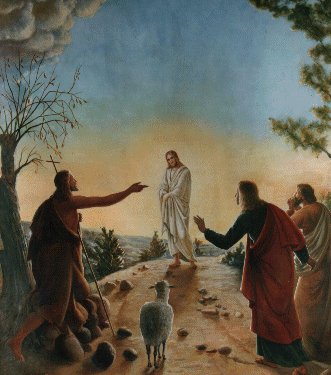
This painting shows John The Baptist on the left refusing to be called the Messiah. Instead, John identifies Jesus as “The Lamb of God who takes the sins of the world.” (Note the lamb in the foreground and the bright sunlight in background. Both the lamb and the light are symbols commonly associated with the Christ’s act of Redemption).
The Transfiguration of Jesus Christ
The next scene recreate the Transfiguration of Christ on Mount Tabor before Peter. John and James. The apostles prostrate themselves or appear ecstatic, for they understand finally the Jesus is truly God come to reiterate the Covenant with Moses and to fulfill the prophecies of Elijah.
The Trinity, Incarnation & Redemption
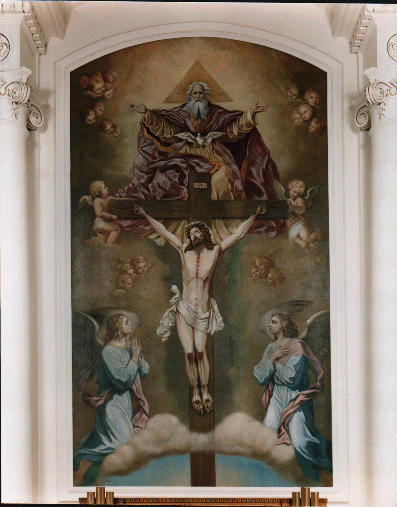
Rising above what was once the main altar and still framed by sculptured columns and an architectural canopy at the sommet of the columns, stands the painting central to the motif of the entire design. Basically it represents the three fundamental mysteries – the Trinity, the Incanartion and the Redemption. Vertically, the painting shows God the Father, open-armed to receive his creation; the Holy Spirit portrayed as the Dove; and the Crucified Christ. The Christ of course, symbolizes the Trinity as well as the Incarnation and the Redemption. Artistically, the nebulous and formless background, symbol of the world, is contrasted dramatically to the bright, bold figure of Christ, the key to the salvation of the world.
The Risen Christ
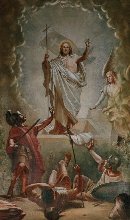
Here is the glorious Risen Christ. Jesus is victorious over Death and Sin (Symbolized by the tomb), over his enemies (Symbolized by the Jewish soldiers struck by fear) and over the doubts of his apostles who now understand His parable about the destruction of the Temple (symbolized by their act of adoration in the painting of the Transfiguration).
Peter Charged with the Flock
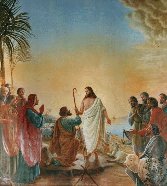
In the centre plan of this next painting, Christ charges Peter with his pastoral mission at the head of the Church with the words ‘Take care of my flocks.’
The Crowning of the Virgin of Heaven
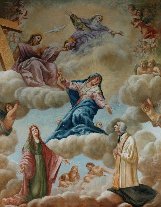
The final painting on the extreme right of the six which dominate the sanctuary corresponds to the first on the extreme left. The promise of the Redemption and Salvation finally realized, the blessed are assembled for the crowning of the Virgin of Heaven. Among the holy ones are St. Phliomena at right, the pastor of Ars who initiated the cult of Philomena at left, and at centre the Holy Innocents.