LOREM IPSUM DOLOR
Saint Philomena
Virgin, Martyr, and Witness of Faith
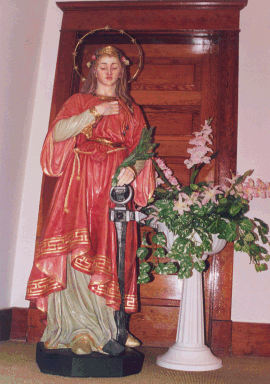
Former Patroness and Titular of the Gravelbourg Parish
In 1908, the Gravelbourg Parish had been placed under the patronage and protection of Saint Philomena, Virgin and Martyr. She had also been the titular of the present Co-Cathedral and the patron saint of the Gravelbourg Diocese until 1963.
In 1961, the Sacred Congregation of Rites sent a decree instructing that Saint Philomena’s Feast Day on August 11, was to be removed from all liturgical calendars of the Universal Church. The Church did not imply that Saint Philomena was never a Saint, authentic Server of God or Martyr of Christ but, that there was no substantial evidence declared to the Church to determine whether she was a true Saint of God. The Church intended to remove from the Saint, not the cult, but only the formalities of the liturgical cult that she had been accorded in an extraordinary manner by the Roman pontiffs since 1837. The Catholic world today continues to venerate and to honour Saint Philomena.
In 1961, the Sacred Congregation of Rites sent a decree instructing that Saint Philomena’s Feast Day on August 11, was to be removed from all liturgical calendars of the Universal Church. The Church did not imply that Saint Philomena was never a Saint, authentic Server of God or Martyr of Christ but, that there was no substantial evidence declared to the Church to determine whether she was a true Saint of God. The Church intended to remove from the Saint, not the cult, but only the formalities of the liturgical cult that she had been accorded in an extraordinary manner by the Roman pontiffs since 1837. The Catholic world today continues to venerate and to honour Saint Philomena.
Bishop Aimé Decosse, the fifth Bishop at the time, after reading the decree of 1961, immediately began removing all statues of Saint Philomena and initiated a search to replace the former titular of the Cathedral as well as the patron of the Gravelbourg Diocese. Bishop Decosse left the selection of the new titular and new patron to the Catholic families and to the clergy of the Gravelbourg Diocese. They could choose among the Transfiguration, the Assumption, Saint Pope Pius X or Saint John Vianney (Curé of Ars). Our Lady of the Assumption was chosen as titular of the Cathedral and as patron of the Gravelbourg Diocese by a majority of 683 voices in 1963.
The Life of Saint Philomena
Little is known about the life of Saint Philomena before the discovery of her celebrated tomb in the Catacombs of Priscillia in Rome. The only information that we have about the Saint derives from the revelation that she made to her fervent devotee, Mother Maria Luisa of Jesus, on August 3rd, 1833.
Saint Philomena revealed her life story while the Holy Sister was in prayer before one of her sacred statues.
She revealed to her: “I am the daughter of a Greek King. My parents were pagans and not having children of their own, they offered sacrifices to false gods. A Christian doctor from Rome told them to be baptized, become Christians and God will give you offspring. They accepted the proposal and were baptized into the Catholic religion. A year later, I was born and was given the name of PHILOMENA.
I grew up with a Christian education, received my first Holy Communion at the age of five and made a vow of virginity to God at the age of eleven.
When I was thirteen years old, Diocletian, a Roman Emperor (second century), declared war on my father. He was forced to go to Rome to make peace in order to avoid the war. It was his wish that my mother and I should accompany him.
When we arrived in Rome, we found Diocletian in the Baths. As soon as he set eyes on me, taken by my beauty, he promised my father peace and protection on the condition that I be given to him in matrimony.
My father consented and leaving his presence, explained to me what had happened. I replied: “I cannot marry him because I have consecrated my virginity to Jesus Christ.”
My father and my mother beseeched me: “Have pity for your father, your mother, your country.” I replied: “My father is God, and my country is Heaven.”
When Diocletian was informed of my decision, he tormented: “If you do not want my love, then you will feel my power!” He quickly ordered that I be chained up in prison with only bread and water once a day.
After thirty-seven days, the Virgin Mary appeared to me and said : “My Chosen Child, you will spend three more days in this prison, then you will suffer various martyrdoms. The Archangel Gabriel and your Guardian Angel will help you and you will emerge victorious.”
After the fortieth day, I was stripped and flogged. My body was covered with wounds and I was thrown back in prison to die. I was visited by two angels and God had cured me that very night.
The emperor proposed marriage to me once again, I continued to refuse and he ordered that I be put to death by a shower of arrows. As soon as I was tied up, I was taken in ecstasy. The arrows, instead of striking my body, turned back, killing several archers.
The emperor struck with anger, again ordered that an anchor be tied around my neck and that I be drowned in the Tiber River. I was saved once more, two angels disattached the anchor and I was brought to land with dry feet. The people witnessing the miracle, began to shout to the executioners: “She’s free! She’s free!” Fearing a popular uprise, I was later decapitated.
This happened on August 10, a Friday, one hour after midday.”
While the Holy See does not guarantee the authenticity of this written revelation, the Holy Office gave its sanction for imprimatur on December 21st, 1883.
The Discovery of Her Relics
Saint Philomena’s relics were unearthed at the beginning of the 19th century. On May 25, 1802, during the excavations being made in the Catacombs of Priscillia, an earthen tomb was discovered. Three tiles placed together closed the entrance, and on them was the inscription which read: LUMENA PAXTE CUM FI. The letters were painted with red lead and surrounded by Christian symbols. After a study, it was evident that these tiles were disarranged, either because they were put in place in great haste, or because someone not familiar with Latin had laid them in the incorrect order. Properly arranged, they read:
PAXTE CUM FI LUMENA
(Pax tecum Filumena!)
PEACE BE WITH YOU PHILOMENA!
In Greek, Philomena means beloved.
Cut on the tomb of the Saint were emblems of a lily and a palm to indicate her virginity and her martyrdom. There was also an anchor, a scourge and three arrows. These signs, which symbolize the type of martyrdom suffered by the Saint, are in agreement with the revelation made later to Mother Maria Luisa of Jesus.
When the stone slabs were removed, there was found within the burial place a glass phial containing blood along with the bones of a female between the ages of 13 and 15. It was blood that was collected at the death of the martyr, according to the customs of the Christians during the persecutions, and was placed with the remains as a testimonial to her death by martyrdom.
Transfer of Her Relics to Mugnano del Cardinale
On August 10th, 1805, the relics and the precious corpse of Saint Philomena were transported by the Pastor of Mugnano, Don Francesco di Lucia to Mugnano del Cardinale, a town near Naples in the diocese of Nola. Overnight, the shrine became a place of pilgrimage where marvelous prodigies and even miracles occurred through the intercession of Saint Philomena. The Church soon recognized a devotion that the Mugnano people quickly developed toward Saint Philomena.
Among many of the miracles was the cure of Pauline Marie Jaricot, the foundress of the Society for the Propagation of the Faith and the Living Rosary. After receiving Holy Communion near the shrine of the Saint’s relics, Pauline Jaricot had been miraculously cured of a hopeless malady through the intercession of Saint Philomena in 1835. She decided to take a relic of Saint Philomena to Lyon and installed it in her chapel where it could be honoured. It was the cure of Pauline Jaricot that led to the formal approval of the cult of Saint Philomena by Pope Gregory XVI. He had given her the title of Patroness of the Living Rosary and Patroness of the Children of Mary. The Pope, in his decree, called the Saint “La Thaumaturga (Wonder Worker) of the Nineteenth Century”. After hundreds of other miraculous cures, she was beatified in 1837.
The Saint Curé of Ars
The little town of Ars, France, has become famous through the holy life and labours of Saint John Vianney, its beloved Curé. He was born in Dardilly, France, on May 8th, 1786, and became the Curé, as pastor of Ars in 1818. He was canonized in 1925 and made patron saint of parish priests. The Curé first came to know of the wonderful power of Saint Philomena through his friend, Pauline Jaricot. She offered him a part of the precious relic of the Saint which she had obtained from the shrine at Mugnano and told him: “Have faith in this little Saint, and you will obtain all that your heart desires!”. He accepted the relic with intense joy and dedicated a chapel to Saint Philomena, whom he called “His dear little Saint”. The shrine soon became the scene of innumerable cures, conversions and miracles.
Only God can number the miracles that occurred in Ars through the intercession of Saint Philomena. Thousands of people made pilgrimages to the chapel of Ars. To each person that requested to be recommended in the Holy Curé of Ars’s prayers, he would say to them: “Recommend yourself to Saint Philomena!” He had an intimate familiarity with her and called her his “chargée d’affaires”. It is said that the Curé did everything for her, and Saint Philomena did everything for him. The Curé of Arts always said that it was due to Saint Philomena and to her intercessions that he received from God almost everything that he desired and that he was able to do so many wonderful things.
Memorable Devotees
Although little is known of her earthly life, Saint Philomena’s witness of faith touched the hearts of many. Among her devoted followers were saints, clergy, and faithful from around the world who sought her intercession and shared their love for this young martyr.
- Pope Leo XII
- Pope Gregory XVI
- Pope Pius IX
- Pope Saint Pius X
- Pope Leo XIII
- Venerate Pauline Jaricot
- Saint John Vianney
- Saint Madeleine Sophie Barat
- Saint Peter Chanel
- Saint Peter Eymard
- Venerate Mother Maria Luisa of Jesus
- Blessed Bartholomew Longo
Msgr. Maillard’s Representation of Saint Philomena’s Life
Discover Msgr. Maillard’s artistic representation of Saint Philomena’s life through a series of paintings that celebrate the story of Gravelbourg’s former patron saint.