LOREM IPSUM DOLOR
A Historical Sketch of Gravelbourg
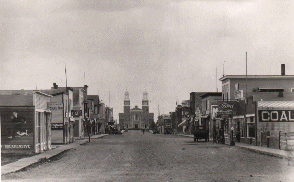
The Saint Boniface episcopate, whose diocese holds jurisdiction on all of the Canadian Northwest, had chosen a desirable region in the Western Plains for the settlement of the French Canadian population arriving from either Québec, Ontario or the United States.
In the fall of 1906, with the insistence of His Grace Most Reverend Adélard Langevin, Archbishop of Saint Boniface, Father Louis-Pierre Gravel, a valiant young priest, was bestowed the responsibility of encouraging French Canadians to settle out West.
Vicar General Dugas, administrator of the Saint Boniface Diocese, sent this very letter to Father Gravel: “Archbishop’s palace in Saint Boniface, September 28, 1906. – Father Louis-Pierre Gravel, the present holder of this letter, is hereby authorized by Archbishop Langevin to found a parish in the area of his choice (understanding that it must be in the South west of Saskatchewan). His Grace blesses this venture with all of his heart. We greatly favour this devoted missionary. He who is agreeable shall be the one with ecclesiastical authority. (signed) F.A. Dugas, p.a., v.g., administrator.”
The following year, on September 8, 1907, a missionary priest, Father J.-Arthur Magnan arrived in Gravelbourg to lay the foundations of a new parish. A Postal Office was established in La Vieille and was given the name of Gravelbourg on March 12, 1907. The first chapel house or “Maison Blanche” was built on July 17, 1908. This newly built chapel was placed under the patronage and protection of Saint Philomena. The new colony developed very quickly. French Canadian settlers had begun flowing into this superb valley since 1907. “School District No 2244” was created the following year.
On March 4, 1910, due to the increasing population in the West and because of the tremendous distances of travel, the Holy See erected Regina as a diocese. In 1911, His Excellency Olivier-Elzéar Mathieu became first Bishop of this newly created diocese.
La Société Saint Jean-Baptiste was first organized in 1912. The Saint Jean-Baptiste Hall (now the Parish Hall) was built in 1913.
The “Large Improvements District” became the “Rural Municipality of Gravelbourg No. 104” on January 1, 1913. The first mayor was Mr.Charles LeMoine and the first secretary treasurer was Mr.Alphonse Gravel. Also in 1913, Bishop Mathieu authorized the construction of a new church. The foundation of the church was completed in 1914, but was later offered to the Collège catholique de Gravelbourg. In September of 1913, the Canadian National Railway linked Gravelbourg with the bigger centres.
In 1914, Gravelbourg had a population of 738. On August 26, 1915, the Sisters of Jesus and Mary arrived in Gravelbourg to replace the lay teachers, who had been teaching at the public school since 1908. The Sisters continued their classes in the little chapel-house “Maison Blanche” from 1915 until they moved into their splendid new convent on August 3, 1918. In 1970, the Sisters decided to sell the Jesus and Mary Convent to the Gravelbourg School Board. Due to ageing, sickness and the decrease in vocations of the younger generation, the Sisters of Jesus and Mary had no option but to leave Gravelbourg on December 13, 2000, after 85 years of pure devotion.
On December 4, 1915, being that the Regina Diocese was raised to the Metropolitan See, His Grace Olivier-Elzéar Mathieu was promoted to Archbishop.
In 1917, Gravelbourg was officially given the title of town.
On December 14, 1918, the Collège catholique de Gravelbourg welcomed its first group of students. In 1976, the Oblate Fathers left Collège in the charge of the Francophone laity and members of the clergy. On May 14, 1988, a tragic fire destroyed Collège Mathieu which was rebuilt in 1990.
In the winter of 1918, the Missionary Oblates of the Sacred Heart and of Mary Immaculate arrived in Gravelbourg to lend a helping hand to the teaching priests who taught in the Collège. Since October of 1919, the Oblate Sisters had offered temporary classes to the younger students and on September 15, 1920, the Sisters opened a Kindergarten dependent on the Collège. In 1929, the Oblate Sisters constructed the Jardin Notre-Dame and continued teaching until their departure in 1964.
Archbishop Mathieu blessed the Jesus and Mary Convent and the Collège catholique de Gravelbourg on January 20, 1919.
In autumn of 1918, after the First World War, began the construction of the present Co-Cathedral which was blessed by Archbishop Mathieu on November 5, 1919. The elegantly displayed interior of this Co-Cathedral is the masterpiece of Msgr. Charles Maillard. The admirable priest-artist devoted ten years (1921 – 1931) of his life to these inspiring art works.
In Gravelbourg, the Court House was built in 1922.
January 14, 1926, was the arrival date of the Religious Adorers of the Precious Blood. The cloister of sisters continued to lead their penitential and prayerful life until the closing of the monastery in 1975.
Gravelbourg welcomed the arrival of the Grey Nuns on July 21, 1927. They founded St.Joseph’s Hospital which had its official opening ceremony on April 29, 1928, on St.Joseph’s feast day. In 1933, “Les Dames Patronnesses de l’Hôpital” (presently called, St.Joseph’s Hospital/Foyer d’Youville Auxiliaries) was founded. The official ceremony of the new St.Joseph’s Hospital/Foyer d’Youville was on November 13, 1996. On October 29, 2000, the Grey Nuns officially turned over the sponsorship of St.Joseph’s Hospital/Foyer d’Youville to the Saskatchewan Catholic Health Corporation but continue to provide pastoral care to the sick and the elderly.
Father Gravel had always dreamed of seeing Gravelbourg as an episcopal town. His dream was realised four years after his death when the Gravelbourg Diocese, released from the Regina Archdiocese, was founded on January 31, 1930. The title of Saint Philomena Church was soon changed to Saint Philomena Cathedral, Cathedral of the Gravelbourg Diocese. Bishop Jean-Marie-Rodrigue Villeneuve, O.M.I., was appointed first Bishop of the newly founded diocese on July 3, 1930. He was elected 20th Bishop and tenth Archbishop of the Québec Archdiocese on December 11, 1931 and was consecrated Cardinal on March 13, 1933. Bishop Louis-Joseph-Arthur Melanson succeeded Bishop Villeneuve on February 22, 1933 and was later elected first Archbishop of the Moncton Archdiocese on December 16, 1936. Bishop Joseph Wilfrid Guy, O.M.I., was Gravelbourg’s third Bishop. Already Vicar Apostolic in Grouard, Alberta, Bishop Guy was established into the Gravelbourg Diocese on October 25, 1937. Bishop Guy resigned from his position in December of 1942 and was soon replaced by the former Bishop of Sendai in Japan, Bishop Marie-Joseph Lemieux, O.P.. On November 26, 1942, he was appointed Apostolic Administrator of the Gravelbourg Diocese until he was appointed fourth Bishop on April 7, 1944. On June 29, 1953, Bishop Lemieux was promoted to Archbishop of Ottawa. The fifth Bishop was Bishop Aimé Decosse who was consecrated in Gravelbourg on January 20, 1954. He remained Bishop for nineteen years before his resignation was accepted on May 14, 1973. Following, was Bishop Noël Delaquis, sixth Bishop of Gravelbourg. He was installed in the Diocese on March 5, 1974 and resigned on April 10, 1995. Bishop Raymond Roussin, seventh and last Bishop of the Gravelbourg Diocese, was consecrated Bishop on June 14, 1995. His Excellency Most Reverend Raymond Roussin was elected Coadjutor Bishop of Victoria on Vancouver Island on September 4, 1998. On September 14, 1998, due to a decrease in population and the limited pastoral resources, the Gravelbourg Diocese was suppressed. Thirty-one parishes were integrated with Regina and the remaining eight parishes were integrated with Saskatoon. The Cathedral of the suppressed Gravelbourg Diocese was given the title of Co-Cathedral of the Regina Archdiocese in remembrance of its illustrious tradition.
In 1932, Father Josaphat Magnan, O.M.I., invited the Canonesses Regular of the Five Wounds of Our Saviour to replace the Oblate Sisters who were responsible for the upkeep of the Collège. These devoted collaborators of the Oblate Fathers remained at the Collège until they were relieved by the Little Sisters of the Holy Family in 1944.
In 1933, Bishop Melanson invited the Sisters of Our Lady of Chambriac to take charge of the domestic duties at the Bishop’s residence. The Sisters’ stay in Gravelbourg commenced on August 28, 1933 and ended on February 12, 1936 when they returned to Ponteix.
It was from September of 1944 until 1976 that the Little Sisters of the Holy Family graciously relieved the Canonesses Regular of their domestic services at the Collège. These Sisters were also in charge of the upkeep of the Bishop’s residence and later the presbytery from 1949 to 1980.
On December 1, 1944, the Little Missionaries of St.Joseph were also in charge of the domestic duties at the Bishop’s residence until their departure in July of 1949.
In 1952, was the inauguration of the C.F.R.G. Radio Station and in 1973, the Gravelbourg and Saskatoon stations were merged and established in Gravelbourg.
In 1975, Bishop Delaquis invited Madonna House to open a poustina in the former Precious Blood Monastery. Madonna House remained in Gravelbourg until 1998.
On November 1, 2000, the Myriam Family was invited by Archbishop Peter Mallon, Archbishop of Regina, to join the Gravelbourg community. At present, they are living in the former Bishop’s residence, which has now been named “Myriam of the Prairies”.